Sunday, 29 November 2020

This weeks 'Bird of the week' is the not so shy 

'Shy Albatross' 

In 2019 I had the chance to do some Guiding for Cradle Mountain Lodge in Tasmania. During my 7 month stay in Tassie, I had some specific birding plans. Most of my life has been spent in Northern Australia, so there were some missing pieces to my birding puzzle. The number one priority was to get myself on a pelagic birding trip. 

                Shy Albatross (tip to tip 2.5metres) 

Together with my partner Winnie and friend Paul Fraser we booked the pelagic trip, leaving from Pirates Bay, on the South East Coast. 

Not far from shore, we started to see some Shy Albatross, my heart was pounding. As we steamed further east, more followed. Eventually we stopped and started to burley. The Shy Albatross grew in  numbers and boldness, soaring a couple of metres above our heads. Binoculars and long camera lenses not needed for this bird. With a wingspan of 2.5 metres (over 8 feet), not the largest by any means, but an amazing sight for anyone who doesn't see these birds often. 
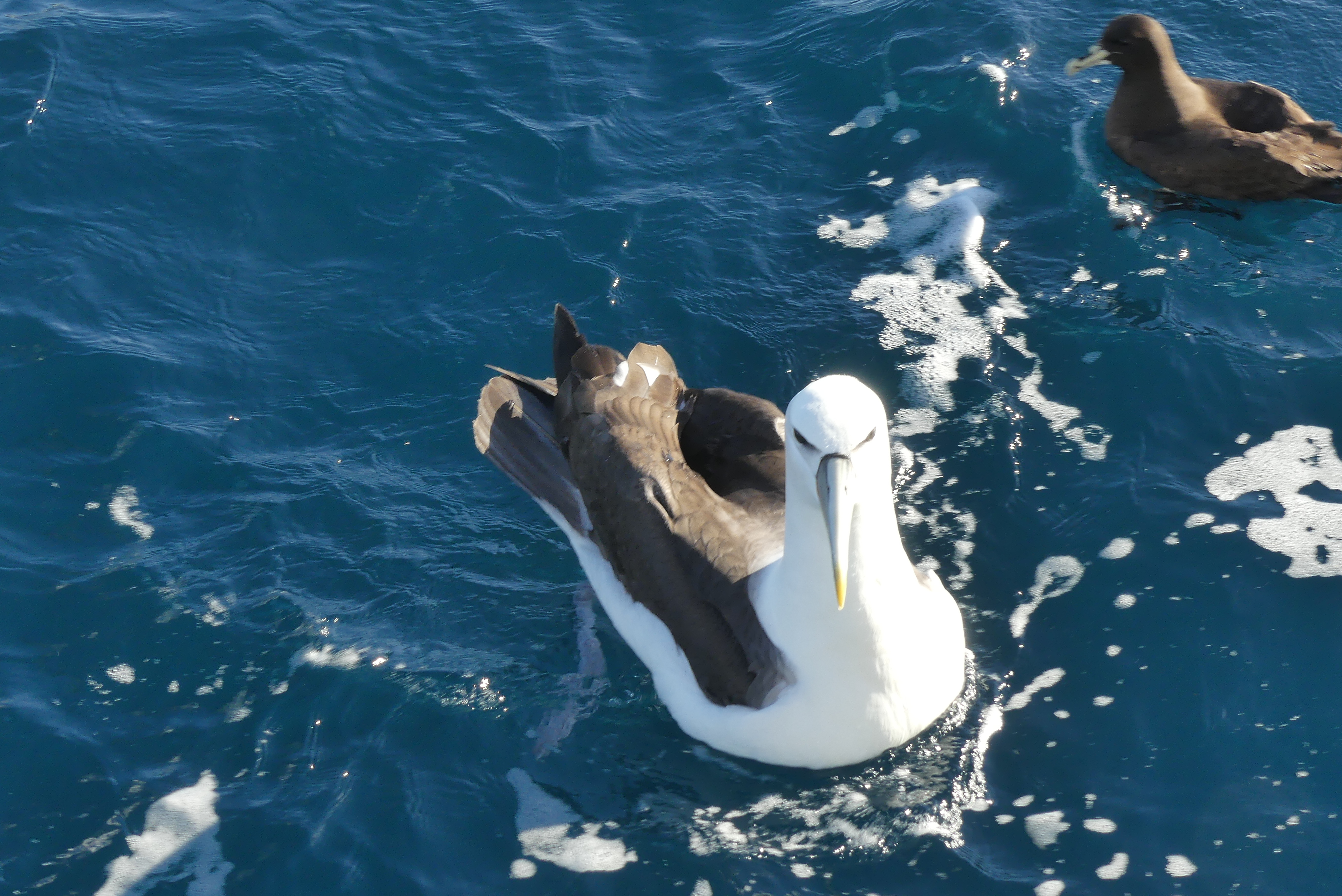
               Shy Albatross, just metres from the boat. 

The Shy Albatross is the most common of the Albatross seen in Australia. All the Albatross species throughout the world are under significant threats from feral pest predation, fishing pressure, floating plastics (they pickup bits of plastic and feed to their young) and habitat destruction. 

A diagnostic of this species is the black notch where the leading edge of the wing meets the body. The only Albatross to breed in Australia on some islands in Bass Strait and southern Tasmania

Whether you are a birder or not, you will get immense satisfaction seeing these giants of the oceans.  

               Hungry Shy Albatross

Note: On this particular day we saw 7 species of Albatross (Wandering, Antipodean, Southern Royal, Northern Royal, Black-browed, Shy and Buller's) and other pelagic species

We will be developing a Tasmania Birding Safari, so follow our blog and facebook pages for future developments. Enjoy! All photos and story by Steve Grainger


Wednesday, 25 November 2020

BELATED BIRD OF THE WEEK

 BLUE WINGED KOOKABURRA


Most English-speaking people over the age of 50 would be familiar with the sound, if not the appearance, of Australia’s Laughing Kookaburra.

In the imaginings of a few generations of Hollywood sound engineers Australia’s Laughing Kookaburra was part of the exotic soundscape that helped conjure a deepest darkest Africa, that was in turn tamed by a single bare chested white man, one Lord Greystoke or more commonly known as Tarzan.

So the Laughing Kookaburra, has a name which is an onomatopoeia based on its call, like the [Eurasian] Cuckoo.

The appearance of the Kookaburra is well known, I would suspect, to every single Australian as it is a large bird [the world’s largest Kingfisher], loud [its chuckling laughter often coming from multiple birds], common and conspicuous [it is found in every capital city in the continent save Darwin].

HOWEVER the Laughing Kookaburra is NOT the Bird of the Week.

But is close relative the slightly smaller lesser known, northern cousin – the Blue winged Kookaburra is!


Our Bird of the Week is a large, loud conspicuous specie too. It is immediately recognisable as a Kookaburra. It has, as its name suggests blue wings. It has a large pale head, lacking the chocolate mask of the Laughing and its bill is huge.

Here on the Sunshine Coast it is a very rare visitor; usually occurring further north.

Sunday, 15 November 2020

Bird of the week, the Kalkadoon Grasswren

Grasswrens! Well if you are looking for a Birding challenge, you really can't go past this group of Australian birds.  

All the Grasswrens are tricky. Some Birders have described them as 'Looking for a needle in a haystack.' Ken Cross describes them as such, but adds 'only the needle is trying to hide from you' 

The Kalkadoon Grasswren, is found in the spinifex lined escarpments, ridges and gullies of the Selwyn Range near Mt Isa in arid North Western Queensland. Appropriately named after the Kalkadoon Aboriginal People of the area. 

Their diet consists of mainly spinifex seeds and insects in about equal proportions. Breeding occurs between July and October. The nest is constructed from grass and twigs and built in the spiked spinifex. Young are fed by both parents and perhaps other members of the troupe

Unfortunately the threats are all to familiar and include inappropriate fire regimes, feral cats, climate change and poor grazing practices. Fortunately recognition and respect of Aboriginal People's, culture and skills, learned over millennia are helping to mitigate these threats. 

Sometimes hours of patience and perseverance are required to find this little bird. I can tell you though, all that effort is most satisfying. 

Keep the dream alive on our North West Queensland Safari for 2021, because the Kalkadoon Grasswren is high on the list. Enjoy


Saturday, 7 November 2020

BIRD OF THE WEEK!


Terek Sandpiper surrounded by Grey tailed Tattlers

Sandpipers are among the last birds, people ‘come to grips with’. They are migratory; meaning, among other things, that they are here in and on Australian wetlands, mudflats and estuaries for only part of the year.  For the part of the year that they are here they have lost their breeding finery so appear in a relatively faded appearance dominated by the colour grey.

And, especially to the beginning birder, they all look annoyingly alike. There is some truth in that statement however when you actually start seriously looking conspicuous differences between the species do become apparent.

To try to encourage more and more folks to begin the highly rewarding past-time of wader watching, allow me to present this week’s Bird of the Week – the charismatic wader; the Terek Sandpiper! 

The Terek Sandpiper is no where near the most common sandpiper to visit Australian shores it is however arguably the most distinct and, I think, charming.

It is distinct for a few reasons.

One  - bright orange legs. You might think that having bright orange legs might make you stand out. And to a degree it does; especially among many of the waders with black legs however it often accompanies the similar sized yellow legged Tattlers.

Second – its bill is slightly upturned. This is in contrast with the normal pedestrian down turned bill that is favoured by almost every other specie.

Third – It runs around quite energetically while it is searching for food and it has a particular jizz as it runs around with its back hunched and its head down making it look even more distinctive.

[BTW -   Jizz or giss is the overall impression or appearance of a bird garnered from such features as shape, posture, flying style or other habitual movements, size and colouration combined with voice, habitat and location. ]

One can expect to see a Terek Sandpiper among flocks of mixed waders anywhere around our continent in the Summer months. Expect to see mostly single birds however occasionally they can be seen in small flocks.

Terek Sandpiper  - Grey tailed Tattler in contrast behind

Cairns Esplanade is one of the best places in Australia to observe waders like the Terek Sandpiper. So consider joining a Wet Tropics to Cape York birding tour to see a huge bunch of species and perhaps your first Terek Sandpiper!

AUSTRALIAN BIRDING SAFARIS

Come birding with us!

Saturday, 31 October 2020

BIRD OF THE WEEK!

 GIBBERBIRD


Fun Fact? Australia is both the flattest and driest continent in the world. Or to put it another way much of Australia is desert. 

So if being an Australian birder demands that you make an attempt to see all of Australia’s birds [and it does..] then one must plan to get to the deserts and see the species that have adapted to survive there.

Which brings me to our Bird of the Week which is such a desert specialist that it is named after a type of desert.

The Gibberbird.


Gibber, according to Wikipedia, is an Australian term referring to a desert surface covered with closely packed, interlocking angular or rounded rock fragments of pebble and cobble size. A common theory suggests they form through the gradual removal of sand, dust and other fine-grained material by the wind and intermittent rain, leaving the larger fragments behind.

So the Gibberbird, and you have guessed this already, lives in Gibber deserts. 

If you look carefully you will see that this picture features more than rocks..

This bird rocks! [See what I did there?]

The Gibberbird is a challenge to see because it lives in these very hard, remote places. It is a small flighty Chat [indeed it is sometimes named Gibber Chat], related to other Australian Chats, that are named not after where they live but after the primary colours of their males; Crimson, Yellow and Orange for example.

Crimson Chat male

Orange Chat female

The Gibberbird feeds on invertebrates unlucky enough to be blown onto the gibber or among small patches of vegetation adjacent. The bird, because it surely does not pay to be too choosy in a desert, also eats seeds. 

Another fact, which is sort of obvious, is that it nests on the ground.

The Gibberbird is similar in plumage between male and female however the male does have slightly stronger yellow across more of its face, chest and belly.

Consider joining us on a safari to the extreme south west of Queensland where we will see desert aplenty and attempt to find some Gibberbirds.

AUSTRALIAN BIRDING SAFARIS
Come birding with us!

Sunday, 25 October 2020

Bird of the Week - October 2020 The Palm Cockatoo

The Palm Cockatoo is one of the world's most sort after birds. On Cape York Peninsula in Northern Queensland, it is locally referred to simply as 'Palmy'. 

It is the largest Cockatoo in Australia, with an 'Elvis' style swept back crest, it's no wonder birders come from near and far to view this genuine character of the bird world.

It is a robust slate-black cockatoo, with a huge bill and orange/pink facial skin, that turns bright scarlet when excited.

The species has several races, with the bird occurring in West Papua and New Guinea as well as Cape York.

Breeding occurs between July and March. Pairs are territorial and resident, nesting in hollows of dead or living Eucalypt trees with suitable hollows. Both partners give a spectacular drumming display at the nest hollow holding a specially prepared stick or seed pod from' The Bushmans Clothes Peg' (Grevillea glauca) in one foot and beating it against the hollow trunk. 

I first saw this behaviour almost 40 years ago, whilst fishing, thus making this bird one of my all time favourites. 

Chiefly a quiet arboreal feeder, taking seeds and fruits from a wide variety of seasonal plants, but also seen on the ground feeding on fallen nuts and fruits. Often seen in Pandanus plants and Beach Almond trees. 

The presence of the bird in a tree can go unnoticed, but for the sound and sight of falling fruit and nuts. When wandering around the bush of northern Cape York keep an eye open, but also keep an ear out for the unique high pitched whistle call, often finished by a short screech. 

The conservation status is uncertain as its home range has changed little. Threats include smuggling, irregular fire regimes that destroy nesting trees plus land clearing. 

Once seen and heard you will be smitten with this icon of the remote and wild region of Cape York peninsula. Every birder needs to go to Cape York. The Palm Cockatoo is a highlight of our Wet Tropics/Cape York safari 


Saturday, 17 October 2020

AUSTRALIAN BIRDING SAFARIS’ BIRD OF THE WEEK OCTOBER 2020

GLOSSY BLACK COCKATOO


Australia has been described as the land of the parrots and with some 60 species of cockatoo, lorikeet, fig-parrots and parrots the description is warranted. Perhaps of all the Australian parrots the ones that command the most respect and awe are the Cockatoos and among them, the group of black cockatoos. 


Female - top picture. Male - picture below

Now this group has a number of species; two near identical species that exist in the south west of Western Australia, the wide ranging Red tailed Black Cockatoo, the Yellow tailed Black Cockatoo, the striking Palm Cockatoo and this week’s Bird of the Week, the glossy Black Cockatoo.

Now as a group these birds are simply awesome; they are not subtle and are loud and huge. Globally Macaws and south east Asian Hornbills are the only birds that come close to demanding a staring, dumbstruck response.

Glossy Blacks, which I will call them, have been chosen as they are able to be seen around my part of the planet, here on Queensland’s Sunshine Coast. 

They are the smallest of the Black Cockatoos. 

And the most specialised; as they appear to feed almost exclusively on the seeds of She-oaks -Allocasuarina species (A. verticillata, A. littoralis, A. torulosa). Cones are picked individually and fragmented in specialized bill to release seeds; these are then separated by working tongue and lower mandible against upper mandible and discarding the chaff. According to Birds of the World their cone-handling time is 40–140 seconds, depending on size of cone. One can walk around a She oak and see the discarded seed pods if the birds have been using it for feeding.

Confusingly, perhaps, they have red tails and thus invite confusion with the Red tailed Blacks but similarities between the two species are limited. The Red tails, pictured below, also overlap with the range of Glossies in part.


Red tailed Black Cockatoos [male upper; female lower]

The species is no where particularly common and has been listed as Vulnerable. The isolated Kangaroo Island sub species is endangered, particularly so after bush fires ravaged their habitat in early 2020.

There has been work on the Sunshine Coast to create and expand habitat for this species with the planting of of Casuarina trees.

On our Brisbane Birding Breaks tour of the Sunshine Coast and Hinterland we will hope to find some of the few Glossy Black Cockatoos.

AUSTRALIAN BIRDING SAFARIS

Come birding with us.