Sunday, 20 December 2020

BIRD OF THE WEEK


Buff-sided Robin


When I first saw the Buff-sided Robin some 40 years ago, whilst visiting Lawn Hill Cattle Station, I was immediately struck by the character of this lovely bird. No long lenses required, just sit, listen and wait and it will come around to inspect you, landing on a branch nearby, to see if you disturb some insect to pounce upon. Like most Robins you can watch them for hours. 


The Buff-sided Robin is found in NE Western Australia, Northern Territory and in Queensland only found within the lower Gulf of Carpentaria region in the North West. 

A solitary breeder in the Spring/Summer from October to March. The nest is built by the female. A clutch of 2 to 3 eggs and one or two broods produced each season. The young are tended by both adults. It feeds mostly on invertebrates, some seeds and inhabits riparian monsoon forests. It can generally be quite easy to see and photograph any time of the year, with a little patience.

A generally common bird in suitable habitat, but appears to be declining as a result of destruction and degradation of riparian vegetation by indiscriminate and poorly managed cattle grazing and feral animals, mostly pigs and cats.


On our North West Queensland tour, the lovely Buff-sided Robin is high on the 'wanted' bird list when we visit Lawn Hill Gorge region.


Saturday, 12 December 2020

BIRD OF THE WEEK!


AUSTRALIAN BUSTARD

This week’s Bird of the Week is a typical Australian Bustard!

Sadly, against common perception, there is only one true bustard in the country.

There are many other bustards across Asia and especially Africa but down under we just have the one.

And like the many other species surviving across the old world it is a deeply impressive bird; Males stand well over a metre tall!

The birds breed using Leks. That is breeding grounds where males gather for the purpose of display. The females observe and take their pick of all of the males present; thus it is they who have their hands on the steering wheel of evolution….

It is a bird quite closely related to the critically endangered Great Indian Bustard. At the risk of getting way ahead of myself perhaps the Australian Bustard could one day be introduced into India as an ecological substitute for the [perhaps] inevitable day that the Indian Bustard slides into oblivion. *Obviously this would only be done if the threatening processes [Hunting is considered the major causal factor] could be controlled.

[On a similar subject, a similar species, the Great Bustard has been recently re-introduced into the United Kingdom. See http://greatbustard.org/the-project/ ]

Great Bustard has been reintroduced on to the Salisbury Plain, UK

An old name for the specie is Plains Turkey. The turkey part of it is particularly ill-deserved however the Plains part of it is useful as this is a bird of grasslands and savanna over much of the northern and central part of the continent.


This bird can be seen on a variety of our tours; indeed many of the trips that venture either north or west there is a better than average chance of a sighting or several.

Saturday, 5 December 2020

BIRD OF THE WEEK


 DUSKY WOODSWALLOW

This week our Bird of the Week is a specie to represent a genus of birds which are primarily Australian in distribution.

The Bird of the Week is the Dusky Woodswallow. And the genus is Artamus and  in it are some eleven species. Six of them are found within Australia. Other members are found in New Guinea, SE Asia, Sulawesi and Fiji. Think of stout little birds that have been created by crossing flycatchers with much sleeker swallows. Like both flycatchers and swallows they feed on insects on the wing.

The Dusky Woodswallow is joined in Australia by the Little, White breasted, Black faced, Masked, White browed.

The Dusky Woodswallow is a predominately brown bird which has a distinct white leading edge on its wing.

It is a migrant that heads vaguely north each autumn and winter; the birds leave Tasmania in April and can be seen as far north as Rockhampton in central Queensland. Certainly each winter on the Sunshine Coast hinterland we can get good numbers of Dusky Woodswallows.

Dusky Woodswallows swarm together to fend off the cold. I captured the image above on a freezing [well very cold] morning in the forests near Jimna, itself on the western parts of the Sunshine coast hinterland. It is an uncommon picture as the birds probably more often than not assemble like this at night.

More commonly on the Sunshine Coast is the White breasted Woodswallow.

To see the other species a Sunshine Coast birder basically needs to head north and west.

Now this is a subject that every birder in Australia has considered from time to time; the naming fiasco that is the Black faced versus Masked in Woodswallows. The short story is the Masked Woodswallow has a large black face [almost exactly like a Black faced Cuckoo shrike]. The Black faced Woodswallow, in an appalling contrast, has a limited area of black on its face, kinda like a mask….. Check out the pictures and decide for yourselves whether a huge error has been made!!

Black faced Woodswallow

Masked Woodswallow

The last two species are better named. The Little Woodswallow is indeed smaller than the rest. It does look superficially like a small Dusky although it does also lack the leading white on the wing.

The White browed Woodswallow is a strongly nomadic bird, ranging over most of the continent, often in the company with Masked. It is difficult to see just one or two of these birds as they are often in very large flocks.     

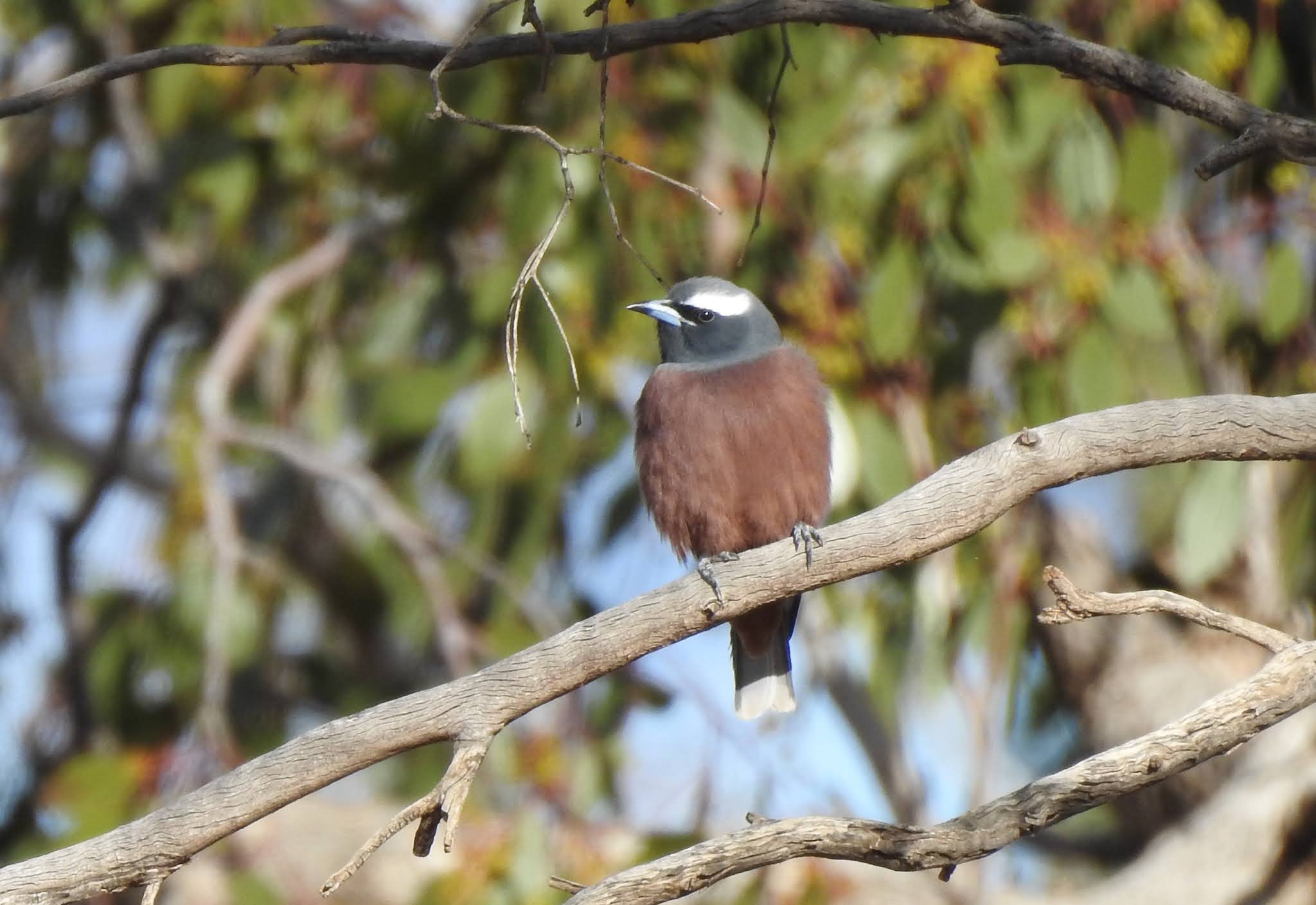
White-browed Woodswallow

Any of our tours that venture in the wilds of western Queensland offer chances to see most of Australia’s Woodswallow species!


Sunday, 29 November 2020

This weeks 'Bird of the week' is the not so shy 

'Shy Albatross' 

In 2019 I had the chance to do some Guiding for Cradle Mountain Lodge in Tasmania. During my 7 month stay in Tassie, I had some specific birding plans. Most of my life has been spent in Northern Australia, so there were some missing pieces to my birding puzzle. The number one priority was to get myself on a pelagic birding trip. 

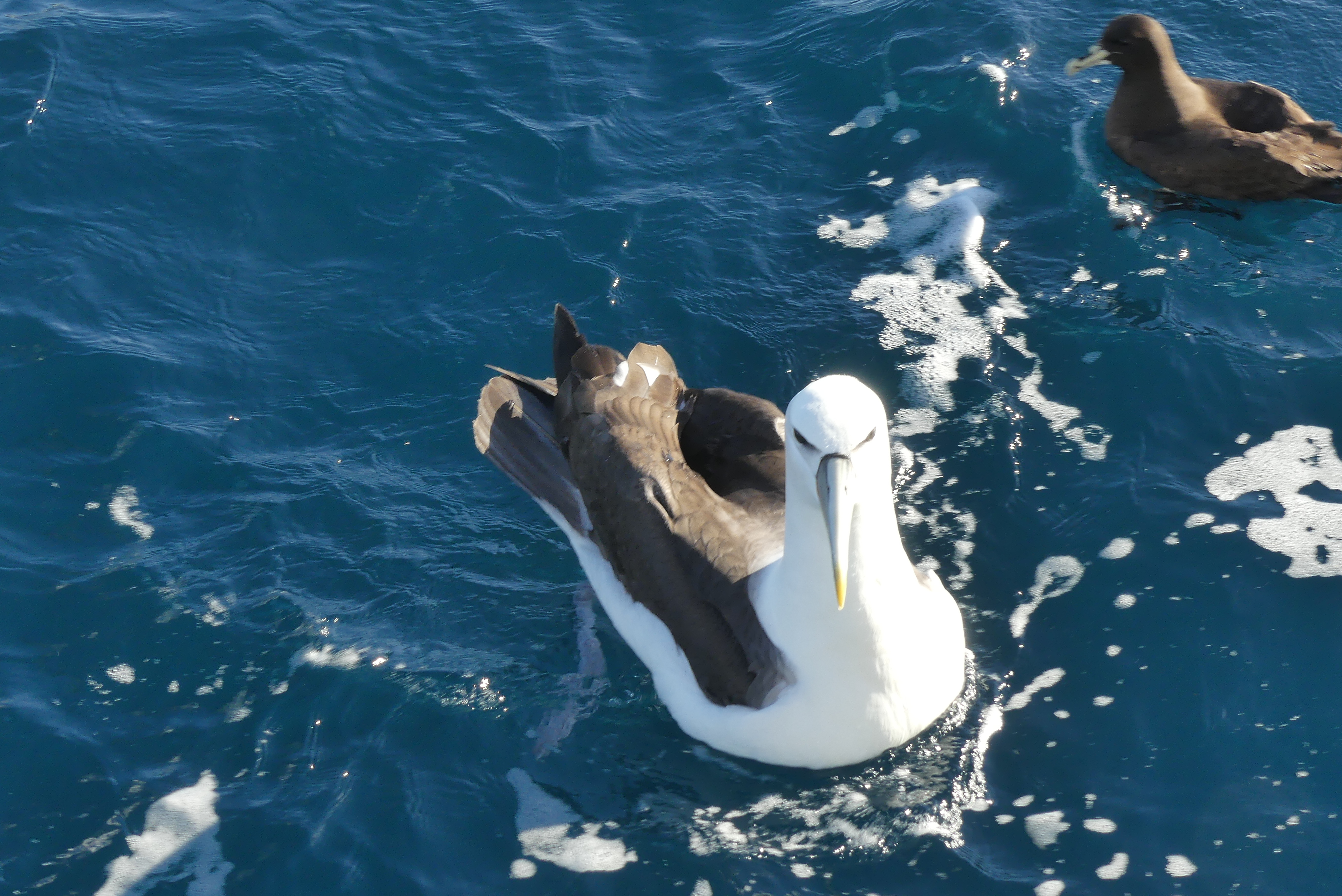
                Shy Albatross (tip to tip 2.5metres) 

Together with my partner Winnie and friend Paul Fraser we booked the pelagic trip, leaving from Pirates Bay, on the South East Coast. 

Not far from shore, we started to see some Shy Albatross, my heart was pounding. As we steamed further east, more followed. Eventually we stopped and started to burley. The Shy Albatross grew in  numbers and boldness, soaring a couple of metres above our heads. Binoculars and long camera lenses not needed for this bird. With a wingspan of 2.5 metres (over 8 feet), not the largest by any means, but an amazing sight for anyone who doesn't see these birds often. 

               Shy Albatross, just metres from the boat. 

The Shy Albatross is the most common of the Albatross seen in Australia. All the Albatross species throughout the world are under significant threats from feral pest predation, fishing pressure, floating plastics (they pickup bits of plastic and feed to their young) and habitat destruction. 

A diagnostic of this species is the black notch where the leading edge of the wing meets the body. The only Albatross to breed in Australia on some islands in Bass Strait and southern Tasmania

Whether you are a birder or not, you will get immense satisfaction seeing these giants of the oceans.  

               Hungry Shy Albatross

Note: On this particular day we saw 7 species of Albatross (Wandering, Antipodean, Southern Royal, Northern Royal, Black-browed, Shy and Buller's) and other pelagic species

We will be developing a Tasmania Birding Safari, so follow our blog and facebook pages for future developments. Enjoy! All photos and story by Steve Grainger


Wednesday, 25 November 2020

BELATED BIRD OF THE WEEK

 BLUE WINGED KOOKABURRA


Most English-speaking people over the age of 50 would be familiar with the sound, if not the appearance, of Australia’s Laughing Kookaburra.

In the imaginings of a few generations of Hollywood sound engineers Australia’s Laughing Kookaburra was part of the exotic soundscape that helped conjure a deepest darkest Africa, that was in turn tamed by a single bare chested white man, one Lord Greystoke or more commonly known as Tarzan.

So the Laughing Kookaburra, has a name which is an onomatopoeia based on its call, like the [Eurasian] Cuckoo.

The appearance of the Kookaburra is well known, I would suspect, to every single Australian as it is a large bird [the world’s largest Kingfisher], loud [its chuckling laughter often coming from multiple birds], common and conspicuous [it is found in every capital city in the continent save Darwin].

HOWEVER the Laughing Kookaburra is NOT the Bird of the Week.

But is close relative the slightly smaller lesser known, northern cousin – the Blue winged Kookaburra is!


Our Bird of the Week is a large, loud conspicuous specie too. It is immediately recognisable as a Kookaburra. It has, as its name suggests blue wings. It has a large pale head, lacking the chocolate mask of the Laughing and its bill is huge.

Here on the Sunshine Coast it is a very rare visitor; usually occurring further north.

Sunday, 15 November 2020

Bird of the week, the Kalkadoon Grasswren

Grasswrens! Well if you are looking for a Birding challenge, you really can't go past this group of Australian birds.  

All the Grasswrens are tricky. Some Birders have described them as 'Looking for a needle in a haystack.' Ken Cross describes them as such, but adds 'only the needle is trying to hide from you' 

The Kalkadoon Grasswren, is found in the spinifex lined escarpments, ridges and gullies of the Selwyn Range near Mt Isa in arid North Western Queensland. Appropriately named after the Kalkadoon Aboriginal People of the area. 

Their diet consists of mainly spinifex seeds and insects in about equal proportions. Breeding occurs between July and October. The nest is constructed from grass and twigs and built in the spiked spinifex. Young are fed by both parents and perhaps other members of the troupe

Unfortunately the threats are all to familiar and include inappropriate fire regimes, feral cats, climate change and poor grazing practices. Fortunately recognition and respect of Aboriginal People's, culture and skills, learned over millennia are helping to mitigate these threats. 

Sometimes hours of patience and perseverance are required to find this little bird. I can tell you though, all that effort is most satisfying. 

Keep the dream alive on our North West Queensland Safari for 2021, because the Kalkadoon Grasswren is high on the list. Enjoy


Saturday, 7 November 2020

BIRD OF THE WEEK!


Terek Sandpiper surrounded by Grey tailed Tattlers

Sandpipers are among the last birds, people ‘come to grips with’. They are migratory; meaning, among other things, that they are here in and on Australian wetlands, mudflats and estuaries for only part of the year.  For the part of the year that they are here they have lost their breeding finery so appear in a relatively faded appearance dominated by the colour grey.

And, especially to the beginning birder, they all look annoyingly alike. There is some truth in that statement however when you actually start seriously looking conspicuous differences between the species do become apparent.

To try to encourage more and more folks to begin the highly rewarding past-time of wader watching, allow me to present this week’s Bird of the Week – the charismatic wader; the Terek Sandpiper! 

The Terek Sandpiper is no where near the most common sandpiper to visit Australian shores it is however arguably the most distinct and, I think, charming.

It is distinct for a few reasons.

One  - bright orange legs. You might think that having bright orange legs might make you stand out. And to a degree it does; especially among many of the waders with black legs however it often accompanies the similar sized yellow legged Tattlers.

Second – its bill is slightly upturned. This is in contrast with the normal pedestrian down turned bill that is favoured by almost every other specie.

Third – It runs around quite energetically while it is searching for food and it has a particular jizz as it runs around with its back hunched and its head down making it look even more distinctive.

[BTW -   Jizz or giss is the overall impression or appearance of a bird garnered from such features as shape, posture, flying style or other habitual movements, size and colouration combined with voice, habitat and location. ]

One can expect to see a Terek Sandpiper among flocks of mixed waders anywhere around our continent in the Summer months. Expect to see mostly single birds however occasionally they can be seen in small flocks.

Terek Sandpiper  - Grey tailed Tattler in contrast behind

Cairns Esplanade is one of the best places in Australia to observe waders like the Terek Sandpiper. So consider joining a Wet Tropics to Cape York birding tour to see a huge bunch of species and perhaps your first Terek Sandpiper!

AUSTRALIAN BIRDING SAFARIS

Come birding with us!